
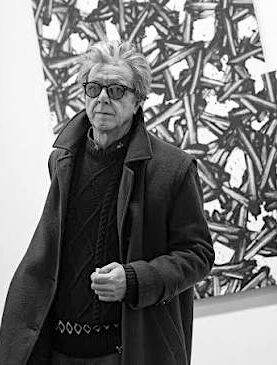
Painting as energy, space, and event
Profile
Gianni Asdrubali was born in Tuscania in 1955, where he lives and works. He is a leading figure in Italian abstract painting who has developed a personal exploration into the relationship between gesture, surface, and space. His work is distinguished by a strong graphic energy and by compositions in which marks, lines, and colour fields seem to emerge from a process of continuous expansion. Painting is not conceived as a window onto an external world, nor as a simple decorative arrangement of forms, but as a place where pictorial action constructs a field of forces.
From Training to Independent Artistic Exploration
Throughout the 1970s and especially in the 1980s, Asdrubali defined a language that distanced itself from both figuration and static geometric abstraction. His mark-making appears rapid, insistent, at times aggressive; however, this apparent spontaneity is underpinned by a control of composition and a constant attention to the relationships between solids, voids, and margins. The works can be read as structures in tension, where each gesture modifies the overall balance and compels the gaze to move without finding a definitive centre.
The Mark and the Pictorial Field
Asdrubali’s surfaces are often traversed by interwoven lines that condense and open in different directions. The mark does not describe an object: it is an event that occupies space. Painting thus presents itself as a dynamic system, in which the rhythm of lines and the density of passages determine perception. The observer is invited to follow visual paths that seem to extend beyond the edges of the canvas, as if the surface were a fragment of a vaster process.
Titles and Method
The titles of his works and exhibitions — often unusual, inventive, or deliberately non-descriptive — contribute to avoiding a narrative reading. They do not offer a figurative key to decipher, but rather accompany the search for an autonomous language. Asdrubali’s painting retains a physical component: the gesture leaves a trace, the surface records the action, the material makes visible the time required for the construction of the image. Yet, it is not an uncontrolled automatism. The work arises from the confrontation between impulse and organisation, between the freedom of the mark and structural necessity.
Exhibitions and Recognition
Asdrubali has exhibited in numerous Italian galleries since the 1980s. Among the exhibitions recalled in his chronology are “Aggroblanda” at Galleria Artra in Milan in 1984, “Bestia” at Galleria La Salita in Rome in 1986, and participation in Aperto ’88, as part of the XLIII Venice Biennale, with a solo room. His career has developed through solo and group exhibitions, accompanied by critical engagement with the transformations of contemporary painting and the renewed interest in pictorial language in the final decades of the twentieth century.
Significance of the Research
Asdrubali’s painting demands an active gaze: it does not offer a subject to recognise, but a situation to traverse. The painting becomes a concentrated visual environment, a field where the energy of the gesture and the organisation of the surface mutually influence each other. His originality lies in having kept painting at the centre of his exploration without reducing it to either representation or pure theory. Each work proposes an ever-new relationship between mark and space, making abstraction perceptible as a concrete and physical experience.
Main Solo Exhibitions
- 1984 – Aggroblanda, Galleria Artra, Milan
- 1986 – Bestia, Galleria La Salita, Rome
- 1986 – Aggancio, Galleria Artra, Milan
- 1989 – Andabata, Galleria Il Milione, Milan
- 1990 – Opere 1978–1990, Palazzo Municipale, Morterone
- 1992 – Mangiaspazio, Galleria Miralli, Viterbo
- 1994 – Universo Tromboloide, Galleria Allegrini, Brescia
- 1996 – Grande personale, Galleria d’Arte Moderna, Palazzo Racani Arroni, Spoleto
- 2001 – Dynamic Structures in Space, Institut Mathildenhöhe, Darmstadt
- 2006 – Stoide, Galleria Artra, Milan
- 2016 – Assolo, Galleria Matteo Lampertico, Milan
- 2018 – Lo spazio impossibile, Museo Carlo Bilotti, Rome
- 2020 – Surfing with the Alien, Galleria d’Arte Moderna “G. Carandente”, Palazzo Collicola, Spoleto
- 2021 – Interazione inconsulta, Galleria Artra e A arte Invernizzi, Milan
- 2024 – Chamorra, A arte Invernizzi, Milan
- 2025 – L’altra pittura, A arte Invernizzi e Artra, Milan.
Main Group Exhibitions
- 1982 – Lapsus, Galleria La Salita, Rome
- 1983 – Risonanza–Résonance, Palazzo Venezia, Rome
- 1985 – Anniottanta, Galleria d’Arte Moderna, Bologna
- 1985 – Astrazione Povera, Galleria Marconi, Milan (and subsequent venues)
- 1986 – Nuove Geometrie, Rotonda della Besana, Milan
- 1986 – XI Quadriennale di Roma
- 1988 – XLIII Biennale di Venezia – Aperto ’88
- 1988 – Sydney Biennale
- 1988 – Schlaf der Vernunft, Museum Fridericianum, Kassel
- 1989 – Orientamenti dell’arte italiana, Moscow and Leningrad
- 1990 – Italian Contemporary Arts, Taiwan Museum of Art
- 1993 – La Fabbrica Estetica, Grand Palais, Paris
- 1997 – Lavori in Corso, Galleria Comunale d’Arte Moderna, Rome
- 1997–2000 – Exhibitions on Italian art at Museum Rabalderhaus (Schwaz), DuMont Kunsthalle (Cologne), Galleria d’Arte Moderna di Bologna, Städtische Galerie (Rosenheim), Fondazione Bandera (Busto Arsizio) and Palazzo Bricherasio (Turin)
- 2011 – 54ª Biennale di Venezia, Italian Pavilion
- 2024 – Dimensionare lo spazio, A arte Invernizzi, Milan.