
Monochrome, relief and the oval shape
Background and early years
Turi Simeti was born in Alcamo in 1929. After studying law in Palermo, he moved to Rome in 1958, coming into contact with the capital’s artistic circles and Alberto Burri, whose exploration of materials exerted a strong influence.
In the following years, he spent time in London, Paris and Basel, engaging with the European avant-garde and the progressive reduction of traditional painting codes.
Towards the monochrome
At the beginning of the 1960s, Simeti progressively abandoned material Informel and developed a practice based on monochrome and relief. The surface of the canvas became a physical space in which form modifies perception.
In 1961, the oval appeared as a central element of his work and gradually became the distinctive shape of his entire production.
The oval and the surface
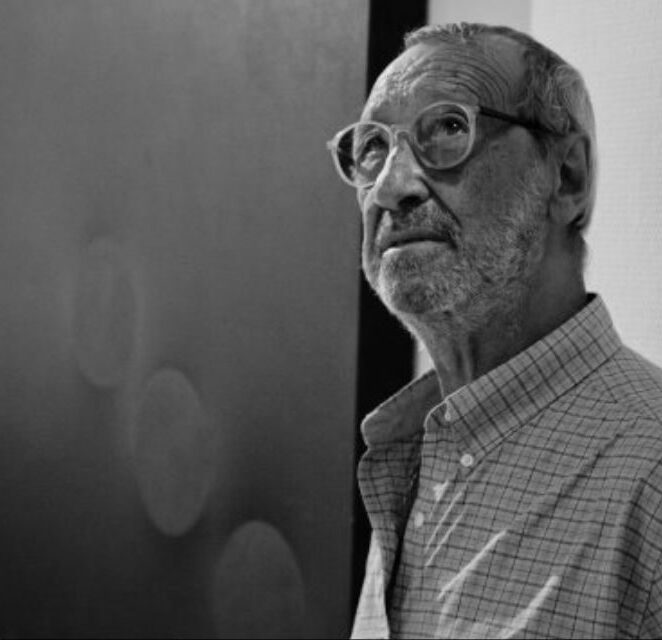
Simeti’s canvases are characterised by monochromes in which ovals and reliefs produce variations of light and shadow. The shape can be repeated, isolated or organised in sequences, creating a tension between flat surface and depth.
The work does not represent an external subject: meaning arises from the direct experience of the surface and the perceptual modifications produced by light.
Milan and the avant-garde
In 1965, Simeti moved to Milan, where he came into contact with Lucio Fontana and the artists associated with the Azimuth circle, including Enrico Castellani, Agostino Bonalumi and Dadamaino.
Between 1966 and 1969, he stayed in New York several times, broadening his engagement with international research into the monochrome and the reduction of form.
Exhibition history and recognition
Throughout his career, Simeti exhibited in Italy and abroad. In 2001, a retrospective exhibition was presented at the Civica Galleria d’Arte Moderna in Gallarate.
International recognition grew in the 2000s. In 2017, the Catalogue Raisonné was published, while his works entered important museum collections, including the Centre Pompidou in Paris.
Critical interpretation
Simeti’s practice is founded on a radical economy of means: monochrome, relief and the oval transform the pictorial surface into a perceptual space.
His work belongs to the history of monochrome painting and Italian spatial research of the post-war period, yet it maintains an autonomous and meditative dimension. The oval becomes an elementary sign capable of generating rhythm, light and depth without resorting to representation.