
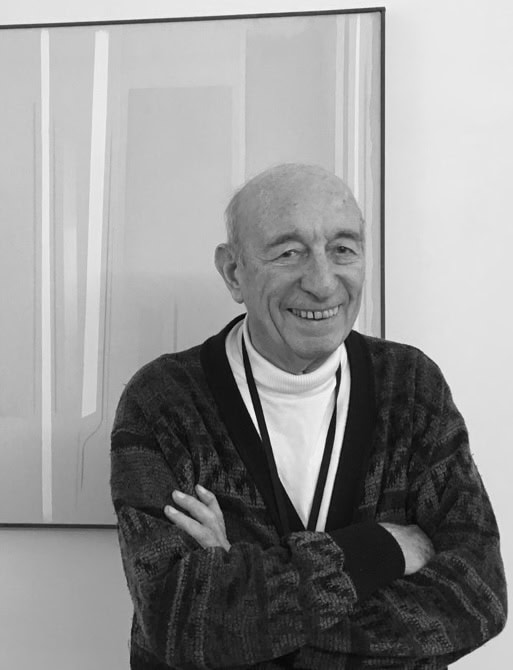
Sign, Light and Perception in Analytical Painting
Early Life and Training
Riccardo Guarneri was born in Florence in 1933 and began painting in 1953, initially combining painting with musical activity. After an early figurative phase, he moved towards Art Informel, but by the end of the 1950s his research had turned to the theme of light.
In 1959 he came into contact with the international art scene of Northern Europe and with key figures of Concrete Abstraction. In 1960 he held his first solo exhibition at the Galerie de Posthoorn in The Hague.
Moving Beyond Art Informel
From 1962, his research focused on the relationship between sign, light and colour. The surfaces became increasingly light and rarefied, while the pictorial matter was reduced in favour of subtle luminous variations.
In 1963 he presented his first paintings characterised by this new sensibility at the Strozzina in Palazzo Strozzi, Florence. Around the same time, he was among the founders of the Tempo 3 group, which aimed to overcome the opposition between geometric abstraction and Art Informel.
Geometry, Light and Analytical Painting
From 1964–65, the composition took on a more rigorous structure, often based on the repetition of slightly asymmetrical squares and rhombuses. Geometry, however, was not a closed system: colour was treated as light and structure as a perceptual element.
In 1966 he participated in the Venice Biennale and the exhibition Weiss auf Weiss at the Kunsthalle in Bern; in 1967 he was invited to the Paris Biennale. His work thus entered the international debate on new abstract painting.
Research from the 1970s
In the 1970s, his painting achieved a progressive rarefaction, with almost white works in which extremely fine marks and luminous transparencies demanded a slow, concentrated gaze. In the 1980s, however, he introduced chance, the stain and watercolour, also using rice paper applied to the canvas.
At the end of the 1980s he returned to canvas, maintaining the use of watercolour and alternating rigorous structures with freer, more rhythmic compositions.
Exhibition History and Recognition
In 1972 the Westfälischer Kunstverein in Münster dedicated a major early retrospective to him. He also took part in the Rome Quadriennale and numerous exhibitions devoted to Italian abstraction and Analytical Painting.
In 2004 the Galleria d’Arte Moderna at Palazzo Pitti presented the retrospective exhibition Contrappunto luce. In 2017 he was invited to the 57th Venice Biennale, Viva Arte Viva. In 2021 four of his works entered the permanent collection of the Centre Pompidou in Paris.