
Mark, Time and Painting as Process
Formation and Early Years
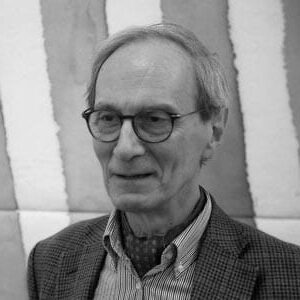
Giorgio Griffa was born in Turin in 1936, where he lives and works. In the 1960s, he developed an independent artistic exploration amidst the new international abstract experiences.
His practice engages in dialogue with Arte Povera, Analytical Painting, and Minimalism, yet remains difficult to categorise within a single movement. His exhibition activity began in 1968.
Painting as Experience
From the outset, Griffa questioned the idea of painting as a finished image. The canvas is treated as an open space in which the pictorial gesture visibly retains its process of formation.
Marks, brushstrokes, and colour fields are deliberately left legible, without being recomposed into a definitive representation. Painting thus becomes a process that unfolds over time.
Mark, Rhythm and Space
One of the most characteristic aspects of Griffa’s language is the use of simple, repeated sequences of marks. Lines, diagonals, numbers, letters, and geometric shapes are organised on the surface without constructing a traditional composition.
Rhythm arises from the repetition and variations of the gesture. Even the void and unpainted areas become active elements of the work.
Cycles of Research
Throughout his career, Griffa developed various cycles, including Connections, Canes, Primary Marks, Fragments, and Numerations. The works retain a strong autonomy but are united by the desire to keep the pictorial process open.
His research also engages with writing, mathematics, and numerical sequences, without losing the immediate character of the gesture.
Exhibition History and Recognition
Since the late 1960s, Griffa has exhibited in Italy and abroad, collaborating with important galleries and participating in surveys dedicated to contemporary painting.
Over time, his work has been presented in important international institutions and museums, with a growing critical re-evaluation of his role in Italian painting of the second half of the twentieth century.
Critical Interpretation
Giorgio Griffa’s painting is based on the idea that the work does not necessarily have to conclude in a definitive form. The gesture remains visible, and time becomes an integral part of the composition.
The apparent simplicity of his marks conceals a reflection on the nature of painting: the canvas does not represent something, but rather makes the very process of painting visible.