
The enigma of everyday objects
Training and early recognition
Tino Stefanoni was born in Lecco in 1937 and died in the same city in 2017. He studied at the Beato Angelico art school and attended courses at the Faculty of Architecture of the Politecnico di Milano. His artistic and architectural training helped define a language based on clarity of line, the simplification of forms, and reflection on objects. In 1967, he was awarded the San Fedele Prize, while in 1968 he presented a solo exhibition at the Galleria Apollinaire in Milan, accompanied by a text by Pierre Restany. In 1970, he was invited to the Experimental Pavilion of the Venice Biennale.
Things as a visual alphabet
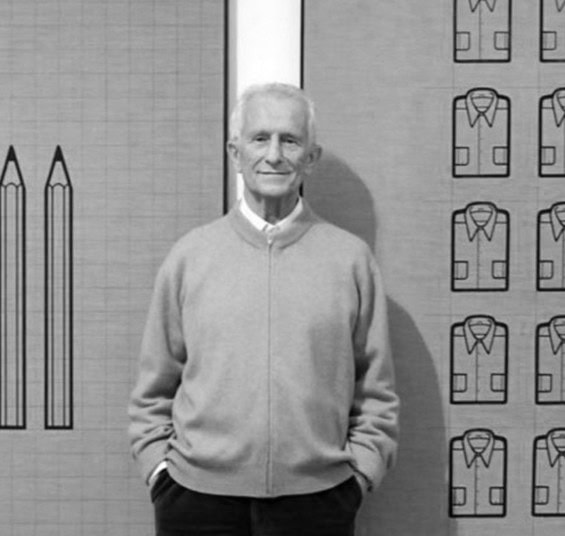
Stefanoni dedicated a fundamental part of his research to everyday objects: shirts, pencils, tools, houses, trees, and other familiar elements. These subjects are isolated, simplified, and presented with an almost didactic clarity. The image seems to belong to a manual or a primer, in which things are shown one by one, removed from the confusion of daily life. It is precisely this apparent obviousness that generates an enigmatic effect: the object is recognisable, but its isolation suddenly makes it feel foreign.
Minimalism, conceptuality, and irony
Stefanoni’s work is often associated with the fields of conceptual art and minimalism, while maintaining autonomous characteristics. Formal reduction does not serve to erase meaning, but to make it more concentrated. The images are sharp, controlled, and often placed in neutral spaces, where the narrative context is reduced to a minimum. The artist thus introduces a subtle irony: the most ordinary objects seem to acquire an unexpected solemnity, as if they were artefacts of an unknown civilisation. Painting does not merely describe things; it interrogates the way we attribute value and familiarity to them.
Painting as a mental object
Stefanoni considered painting an object for the mind, just as a chair or a table are objects for the body. This idea helps in understanding his attention to the structure of the image and the distance between representation and presence. The works do not aim to reproduce the world in a naturalistic way, but to construct a mental form of reality. The controlled drawing, calibrated light, and often restrained colour produce a temporal suspension: things seem removed from use and consigned to silent contemplation.
Landscapes, sinopie, and developments
Alongside objects, Stefanoni developed simplified landscapes and images in which reality is transformed into an essential scene, suspended between presence and memory. In later stages, he also worked on sinopie and drawings in which colour is reduced until it almost disappears, allowing the relationship between line, shadow, and surface to emerge. His research maintains a profound consistency: whether dealing with a tool or a landscape, the image is subjected to a process of simplification that reveals its mental and symbolic character.
Legacy and archive
Stefanoni’s production is documented in the catalogue raisonné published in 2017, which collects works from 1965 to 2016. In 2019, his heirs established the Tino Stefanoni Archive in Lecco, with the aim of protecting and promoting his work, organising exhibition initiatives, and preserving documentary materials. The archive also carries out verification and authentication of the works. This attention testifies to the desire to keep accessible a body of research that, through simple and sharp images, was able to transform the everyday into a territory of philosophical inquiry.