
Sculpture, Material and Light
Profile and Background
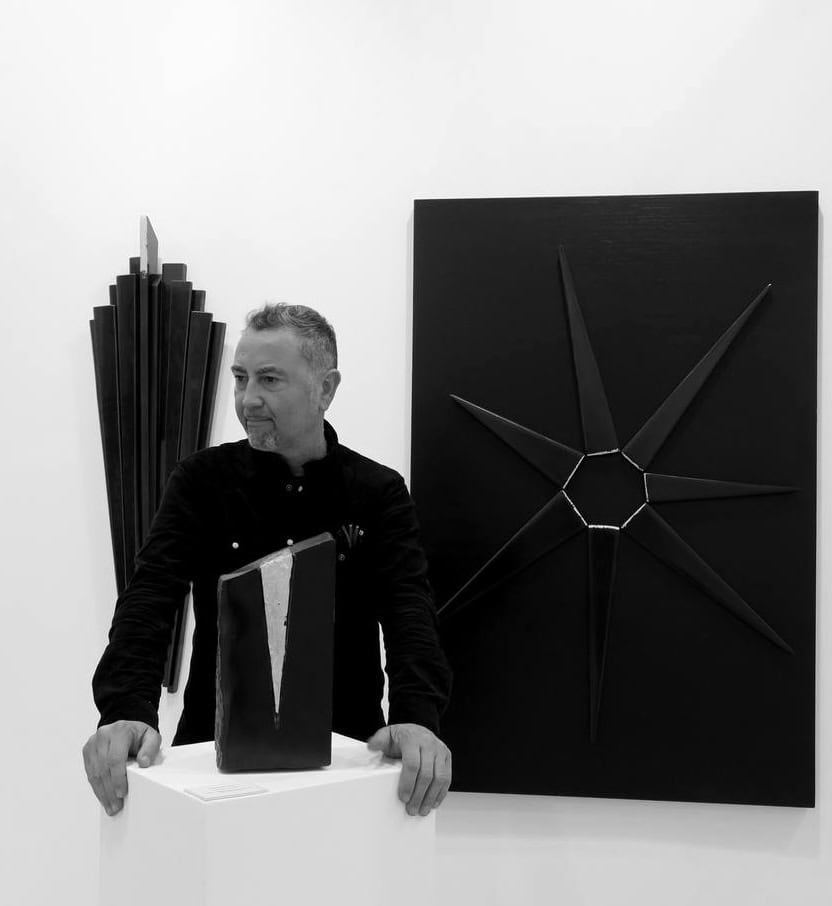
Gioni David Parra was born in Pisa in 1962, lives in Viareggio and works in Pietrasanta. A painter and sculptor, he has progressively developed a practice that spans different materials and languages, before focusing particularly on stone carving. The Apuan-Versilian context, with its sculptural tradition and the presence of marble workshops, constitutes a significant reference, but his practice is not limited to artisanal continuity: it is oriented towards formal experimentation and the construction of a personal language.
Stone Material
Granite, onyx, quartzite, travertine and, above all, marble are the materials through which Parra investigates the relationship between form, light and perception. Stone is chosen for its specific qualities: hardness, veining, transparency, colour and its ability to reflect or absorb light. The sculptural work arises from a direct engagement with these characteristics. The artist does not consider material as a passive support, but as an element that actively participates in defining the artwork.
Series and Vocabulary
His journey has seen the development of recognisable groups of works identified by titles such as “Bladelight”, “Stele Bladelight”, “Nocube”, “MatterConceptual”, “Stone Textures” and “MatterSpirit”. These series do not correspond to repetitive formulas: each work retains its own individuality, while the title identifies a field of research. Forms oscillate between geometry and irregularity, compactness and openness, balance and imbalance. Sculpture can be placed on the ground, on a base or suspended, extending the dialogue with space.
Solid, Void and Light
One of the central themes is the relationship between solid and void. Parra works on the possibilities of form to open up, interrupt or appear poised, transforming the stone mass into a visual structure lighter than the material’s nature would suggest. Light is crucial: it flows over surfaces, highlights veining and alters the perception of volumes. The work presents itself as a field of relationships between material, illumination and viewpoint.
Beyond Traditional Sculpture
Alongside stone, the artist has developed paintings, large-field textiles and installations, including aerial ones. This plurality does not disperse his research but expands its scope: the relationship between material and space can be addressed through different languages. His works have been presented at national and international fairs and exhibitions, and have entered museum collections. Parra has also created public interventions, engaging with architectural dimensions and collective enjoyment.
Critical Interpretation
Gioni David Parra’s research is an investigation into the possibility of freeing matter from its apparent weight and transforming it into luminous form. Stone, associated with permanence and gravity, undergoes a process that accentuates its lightness, tension and openness. The result retains the concreteness of sculpture but introduces an almost immaterial dimension. The work connects manual skill, design and experimentation, making material the starting point for a reflection on space and perception.