
Figurative Painting, Allegory and Imagination
Education and Early Years
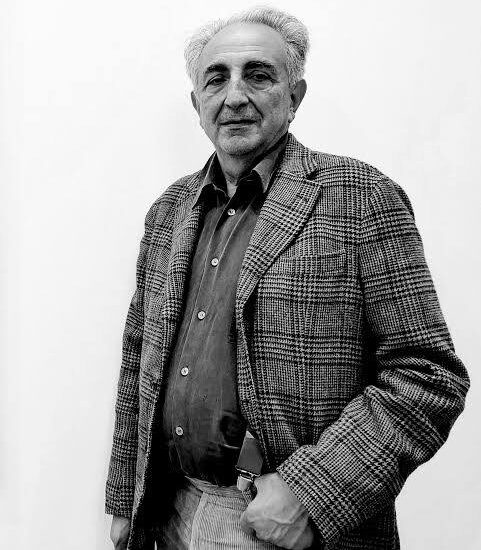
Stefano Di Stasio was born in Naples in 1948 and established himself in the Italian art scene through a cultivated and deeply personal figurative painting. His research developed during a period when many artistic practices questioned the centrality of painting, favouring conceptual, installation, and performance languages. Di Stasio chose to keep the canvas at the core of his work, reactivating the figurative tradition and transforming it into a tool for constructing enigmatic and narrative images.
The Return to Figuration
His works feature figures, architecture, objects, and landscapes painted with great attention to drawing and perspective construction. The subjects are recognisable, but they do not belong to an immediately identifiable everyday reality. They are placed in suspended scenarios, where time seems slowed down and the relationships between elements remain ambiguous. Figuration thus becomes a way to open up an imaginative space, rather than to faithfully describe the world.
Allegory and Theatre
The compositions often have a theatrical structure. The characters appear as motionless actors or protagonists of a ritual whose rules we do not know. Stairs, rooms, backdrops, and architecture organise the scene like a mental stage. The artist does not provide an explicit plot: he allows symbols and gestures to suggest different narrative possibilities. The allegory remains open, allowing the viewer to activate personal associations and cultural references.
Technique and Tradition
The meticulous attention to drawing, light, and perspective recalls the great tradition of European painting. However, technical precision does not serve a purely mimetic function. It serves to make a universe credible that is, in reality, constructed by imagination. The sharpness of the image accentuates the disorienting quality of the scene: the more defined the objects appear, the more their ensemble seems to elude a rational explanation. Painting thus positions itself between verisimilitude and mystery.
Artistic Journey
Di Stasio has been associated with the revival of Italian figurative painting between the 1970s and 1980s and with the so-called New Roman School. Throughout his career, he has participated in solo and group exhibitions in important galleries and institutions, consolidating an autonomous position relative to dominant trends. His output has maintained strong coherence, while expanding his iconographic repertoire and compositional solutions over time.
Critical Interpretation
Stefano Di Stasio’s painting narrates without explaining. The images possess a narrative structure, but they resist a singular interpretation; tradition is recovered not as nostalgia, but as a heritage of forms and symbols to be recirculated. The painting becomes a place of apparition, memory, and inquiry, where the viewer is invited to pause and construct their own interpretive path.