
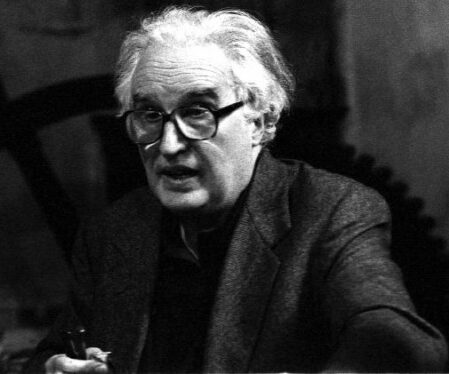
Action music, gesture and conceptual freedom
Profile and background
Giuseppe Chiari was born in Florence in 1926 and died in the same city in 2007. A composer, pianist, conceptual artist and author of theoretical texts, he was one of the most original Italian figures of the international avant-garde in the latter half of the 20th century. His training was interdisciplinary: he combined university studies in engineering with the study of piano and composition. This dual focus on structural reasoning and musical experience contributed to an approach that would challenge the very definition of music and the work of art.
From composition to experimentation
From 1950 onwards, Chiari developed compositions in which notation, gesture and the performer’s behaviour could assume an importance equal to or greater than the sound itself. The encounter with the experiments of John Cage was fundamental: sound did not necessarily have to obey a traditional structure, and silence, chance, environment and action could fully enter the composition. In 1961, he founded the Vita Musicale Contemporanea association with Pietro Grossi, contributing to the dissemination of unconventional musical experiences.
The relationship with Fluxus
From 1962, Chiari became involved with Fluxus, an international network of artists seeking to bridge the boundaries between music, visual arts, theatre and everyday life. His works were presented in the movement’s festivals and concerts, including the Fluxus Internationale Festspiele Neuester Musik in Wiesbaden. For him, Fluxus was not merely a group affiliation, but an ideal context for shifting focus from the finished product to the action, from virtuoso skill to the situation, and from specialised language to an accessible, sometimes provocative experience.
Gestures, scores and performance
Works such as “Gesti sul piano” and “Per arco” transform performance into a reflection on the body, the instrument and musical conventions. The piano can become a surface to be touched, struck or traversed with gestures not prescribed by traditional technique; the bow can be subjected to an action that makes the physicality of the sound visible. In these works, the gesture does not only serve to produce music: it is the content of the work itself. Silence and everyday noises are also recognised as legitimate sound materials.
Writing and thought
Chiari accompanied his artistic practice with books, notes, aphorisms and reflections on music, harmony and method. His writing is often direct and paradoxical, consistent with a body of work that tests the viewer’s expectations. The critique of conventions does not translate into an indiscriminate rejection of tradition; rather, it aims to show that musical rules are historical constructions and can be called into question. His participation in visual poetry research and interdisciplinary contexts confirms his refusal to recognise rigid hierarchies between languages.
Legacy
Chiari’s significance lies in having contributed to redefining the work of art as a process, event and idea. The audience is no longer merely the recipient of a completed composition, but part of a situation in which sound, gesture and anticipation are made perceptible. His research anticipates many contemporary performative and conceptual practices, in which action can matter more than the object and experience more than representation. The playful and sometimes ironic dimension does not diminish the radical nature of his proposal: listening also means questioning the habits through which something is recognised as music.