
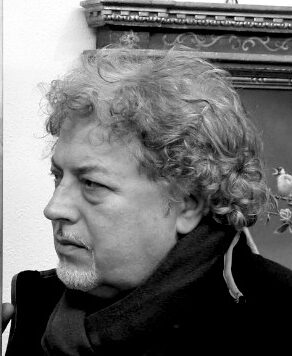
Contemporary Metaphysics and Inner Landscape
Education and Early Years
Antonio Nunziante was born in Naples in 1956 and developed his painting practice through a journey that combines the study of tradition, technical research, and the construction of a personal imaginary. His painting has established itself within the tradition of metaphysical figuration, where objects, architectures, and landscapes are removed from everyday life and placed in suspended environments. The reference to great Italian and European painting is constant, yet it is reinterpreted within a contemporary dimension.
The Metaphysical Dimension
Nunziante’s compositions are often characterised by essential architectures, deep perspectives, isolated objects, and silent atmospheres. Reality appears recognisable, but its order is altered: elements seem to belong to an indefinite time and a mental space. Metaphysics does not equate to a repertoire of citations, but rather to a mode of perception in which things lose their ordinary function and become enigmatic presences.
Technique and Tradition
The painting is distinguished by its meticulous attention to perspectival construction, light, and the rendering of materials. Nunziante looks to the tradition of old masters, studying their processes and atmospheric qualities. His technique contributes to making the depicted world credible, yet it does not negate its imaginary nature. The precision of details accentuates the suspension of the scene: what appears familiar is perceived as distant, almost belonging to a memory.
Landscape and Memory
The landscape often assumes an interior function. Open spaces, skies, architectures, and objects seem to guard a memory that cannot be traced back to a specific event. The painting constructs places of contemplation, where time appears slowed or still. The viewer is invited to enter a scene that does not narrate an event, but rather suggests an emotional state. The poetic dimension arises from the relationship between formal order and mystery.
Exhibition History
Nunziante has exhibited in numerous solo and group shows in Italy and abroad, reaching an international audience also through the dissemination of his works in private collections. His activity has been accompanied by publications and catalogues that document the evolution of a practice that has remained faithful to figurative painting. Over time, he has expanded his subjects and compositional solutions, maintaining the central construction of suspended spaces and images with a strong atmospheric quality.
Critical Interpretation
Antonio Nunziante’s painting proposes a form of realism that does not seek to describe the world as it appears, but rather to restore its secret dimension. Traditional technique is used to construct images that escape chronicle and linear narration. The precision of form coexists with the indeterminacy of meaning, generating a tension typical of metaphysical sensibility. The works invite a slow and contemplative viewing, in which the landscape becomes a projection of memory and imagination.