
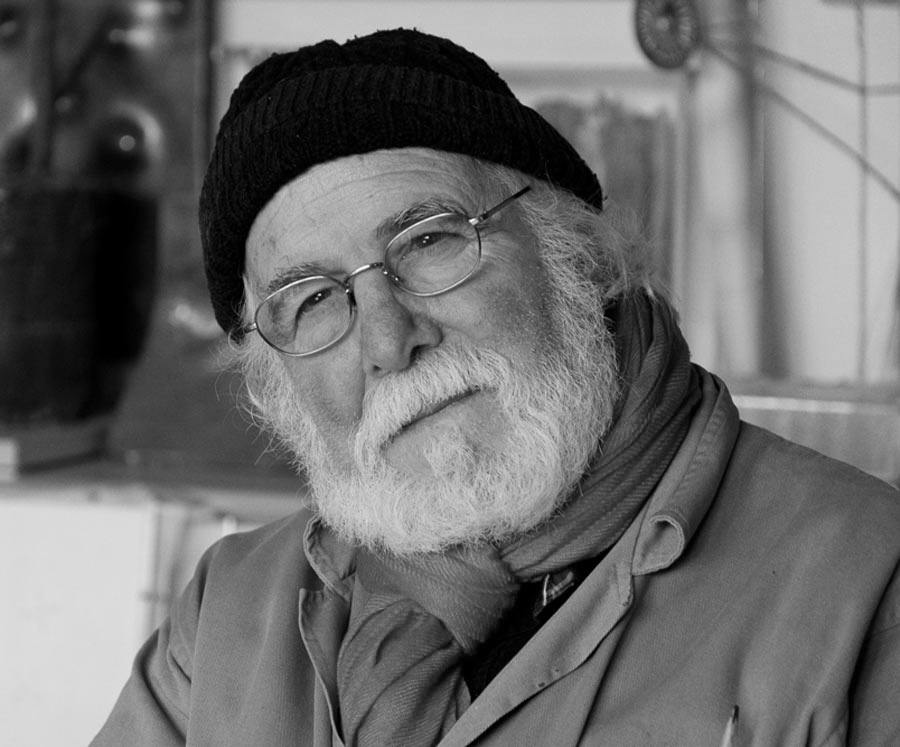
Matter, space and experimentation in an artist’s research
Training and early years
Armando Marrocco was born in Galatina in 1939. He trained at the Art Institutes of Galatina and Lecce, where he graduated in 1959. His early works are characterised by research into matter and assemblage, already oriented towards moving beyond traditional painting. In 1960 he created Ettore e Achille, a concrete sculpture, and in 1961 he participated in the IX Rome Quadriennale.
His meeting with Lucio Fontana in 1959 represented a fundamental moment for his development and contributed to his decision to move to Milan in 1962. In the city, he came into contact with the art, architecture and design circles, developing research that was increasingly open to experimentation.
The Intrecci (Interlacings) and geometric research
In Milan, Marrocco approached the experiences of programmed and kinetic art. This led to the Intrecci, initially created with packaging cardboard and subsequently with steel, industrial materials and reflective surfaces. The geometric structure is thus placed in relation to matter, light and space.
In 1966 he held his first Milanese solo exhibition at the Galleria Montenapoleone and in 1967 he received the Silvestro Lega Prize. He also participated in important collective experiences of contemporary research, including Campo Urbano in Como in 1969, entering into dialogue with new trends in Italian art.
From object to action
Between the late 1960s and early 1970s, Marrocco radically expanded the concept of the work, involving the body, the environment, nature and behaviour. In 1968 he created Uomo e Formica (Man and Ant), presented in 1971 at the Galleria Apollinaire in Milan, where a habitat with live ants became an integral part of the work.
Simultaneously, he developed performances, installations and actions in which the work becomes an open process. In the Tele colorate per combustione di fumogeni (Canvases coloured by smoke bomb combustion), colour is born through smoke and combustion, while in the subsequent Fasciature (Wrappings), fragments of canvas, wood, fabric and other materials are assembled and wrapped, creating forms that evoke archaeological finds and archaic structures.
Writing, memory and archetypes
In the 1970s, Marrocco also brought experimentation into the field of writing. In the cycles Paleo-grafia, Rivelazione and Scrittura bocca, the sign is transformed into a physical gesture and writing loses its communicative function to become a trace of the body.
From 1976 onwards, he also participated in the ‘active writing’ experiences promoted by Ugo Carrega at the Mercato del Sale in Milan. Parallel to this, he developed the Fasciature, the Dimore (Dwellings) and other works in which contemporary materials and archetypal forms enter into relationship with memory, ritual and the symbolic dimension.
Space and the cosmic dimension
In the 1980s and 1990s, Marrocco’s research took on an increasing environmental and monumental dimension. He created installations, public works and site-specific interventions, transforming space into an integral part of the work. This gave rise to the Dimore, the Mappe stellari (Star Maps), the Andromede and the Battaglie nel cielo (Battles in the Sky), in which geometry, matter and symbol are brought back to a reflection on the relationship between man and the universe.
Among his most important interventions are the Città Palafitta (Stilt City) created for the Seoul Olympic Park in 1988, the Fontana del Sole (Fountain of the Sun) in Galatina and numerous public and sacred art projects. A significant part of his production is indeed dedicated to the relationship between art, architecture and spirituality.
Critical reading
Armando Marrocco’s research spans over sixty years of experimentation, without adhering permanently to a single movement. From matter to geometry, from programmed art to performance, from writing to installation, the artist has progressively expanded the very concept of the work, relating object, body, environment and space.
His production is characterised by the continuous transformation of materials and the ability to bring industrial, natural and everyday elements back to a symbolic dimension. It is a research in which experimentation and memory, rationality and the archaic dimension coexist, building a personal and recognisable language within post-war Italian art.