
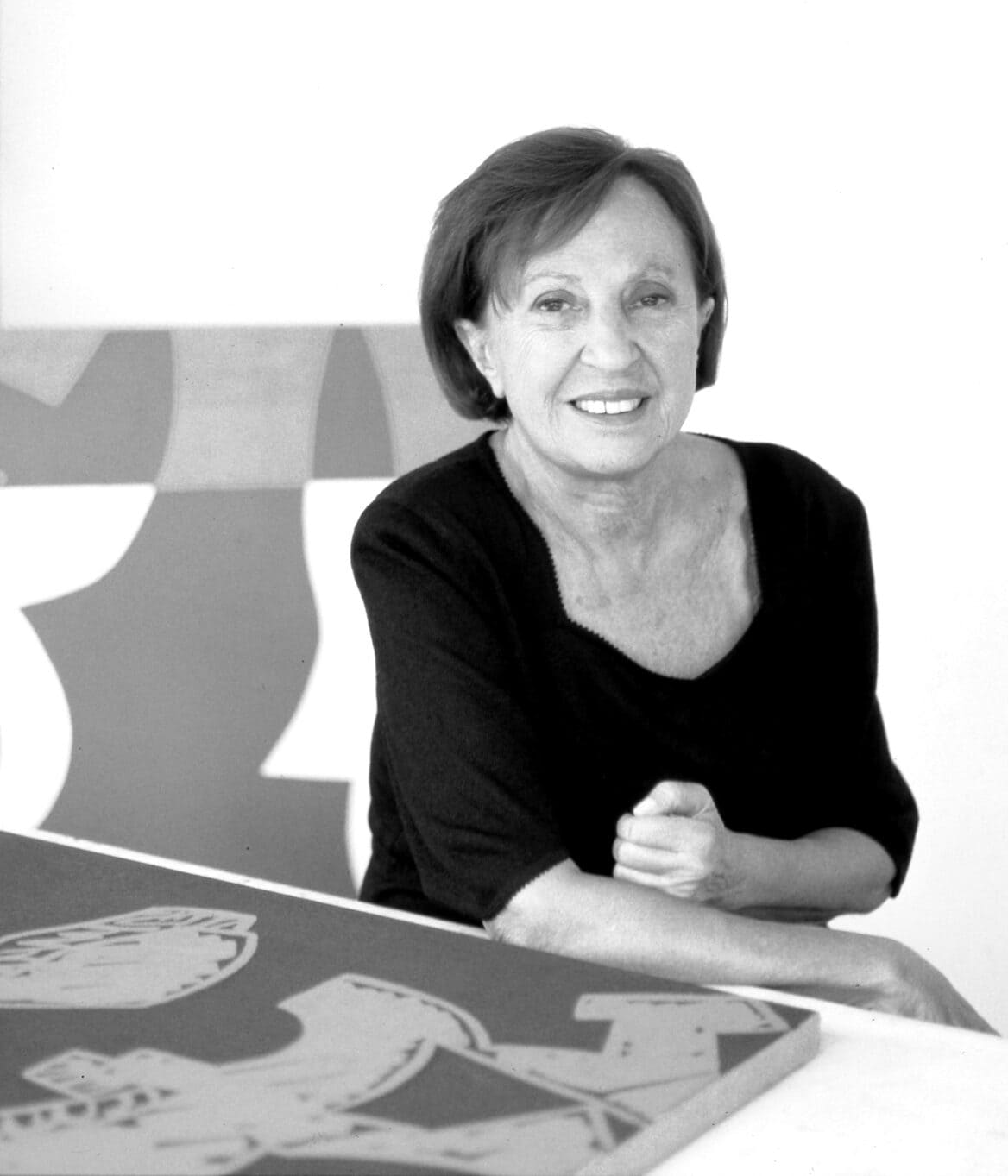
Sign, Colour, and Space in the Pursuit of Abstraction
Education and Early Years
Carla Accardi was born in Trapani on 9 October 1924. After completing her classical and artistic secondary education, she attended the Academy of Fine Arts in Palermo and subsequently in Florence. In 1946, she moved to Rome, where she came into contact with some of the leading figures of the young Italian avant-garde, including Pietro Consagra, Piero Dorazio, Achille Perilli, Giulio Turcato, and Antonio Sanfilippo, whom she married in 1949.
In 1947, she signed the manifesto of Forma 1 with other artists, a pivotal group for the dissemination of abstraction in post-war Italy. Her artistic exploration thus stemmed from a desire to transcend figurative tradition and construct a language based on the autonomy of form, sign, and colour.
The Mark and Black and White Painting
During the 1950s, Accardi progressively developed a personal language centred on the mark. Her compositions gradually abandoned the geometric structure of her early works, focusing instead on white, sinuous, and rhythmic traces, generally executed on a black background.
The mark thus became the true protagonist of the pictorial surface: it did not represent anything recognisable, but rather constructed an autonomous form capable of creating tensions, rhythms, and visual spaces. This research led Accardi to be recognised among the most important figures of Italian abstraction and of Art autre, championed by the French critic Michel Tapié.
Colour and Sicofoil
In the early 1960s, Accardi reintroduced colour into her painting, using increasingly luminous tones and experimenting with new relationships between mark, surface, and perception.
By the mid-decade, she progressively abandoned traditional canvas to use sicofoil, a transparent plastic material onto which she applied coloured and fluorescent varnishes. This period saw the creation of works such as the Rotoli (Rolls) and the Tende (Curtains), in which painting transcended the two-dimensional surface and assumed a spatial and environmental dimension.
The transparent support allowed the colour to interact with light and the surrounding space, transforming the artwork into an element that modified the perception of the environment.
The 1970s and Feminist Engagement
In the 1970s, Accardi continued to develop her research through geometric structures, installations, and new possibilities for the relationship between painting and space. During this period, she also created the Lenzuoli (Sheets) and other works characterised by the repetition of forms and marks.
Concurrently, she participated in Italian feminist discourse, and in 1970, she was among the founders of Rivolta Femminile (Female Revolt) alongside Carla Lonzi and Elvira Banotti. The artistic and social dimensions thus entered into dialogue, without interrupting the continuity of her research into the mark and perception.
The Return to Canvas and International Recognition
In the 1980s, Accardi returned to working primarily on canvas, developing a language in which marks and chromatic fields combined through new forms of balance and juxtaposition. Her research continued to evolve, maintaining the central relationship between sign, colour, and space.
She participated multiple times in the Venice Biennale, with a solo room in 1964 and again in 1988, in addition to her presences in 1976, 1978, 1993, and 2011. Her works were also presented in important international exhibitions, including Italian Art in the 20th Century at the Royal Academy in London in 1989 and The Italian Metamorphosis 1943–1968 at the Solomon R. Guggenheim Museum in New York in 1994. In 1996, she was appointed Academician of Brera.
Critical Interpretation
Carla Accardi’s artistic journey represents one of the most original paths in Italian abstraction of the post-war period. Her work developed through a continuous transformation of the relationship between sign, colour, and surface, never abandoning the idea of painting as an autonomous space for research.
From the rigour of the black and white marks of the 1950s to the luminosity of colours and the transparency of sicofoil, and finally to the return to canvas in the 1980s and 1990s, Accardi constructed a recognisable language that was constantly open to experimentation.
The mark, a fundamental element of her work, did not assume a representational function, but became gesture, rhythm, and form. Her research thus contributed decisively to the renewal of Italian abstract art, affirming a conception of painting capable of transcending the limits of the surface and engaging directly with space, light, and perception.