
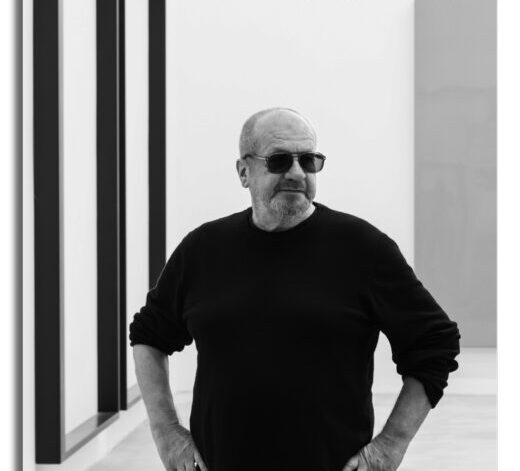
Abstraction, Frame, and Essential Form
Education and Career
Gerold Miller was born in Altshausen, Germany, in 1961. He studied art at the State Academy of Art in Stuttgart from 1984 to 1989, after which he developed a practice focused on geometric abstraction and the relationship between painting and object. Scholarships obtained in the early 1990s, including a stay in Chicago supported by the DAAD, and a subsequent residency in Paris, helped integrate him into an international context. Miller lives and works in Berlin and Pistoia.
Reduction as a Choice
Miller’s work is characterised by a drastic reduction of the visual vocabulary: rectangles, lines, colour fields, smooth surfaces, and sharply defined structures. This essential quality does not equate to a mere decorative pursuit. The artist questions the distinction between painting and sculpture, between image and object, between painted surface and structure in space. The works sometimes appear as frames devoid of an image, or as paintings that have abandoned all reference to a recognisable subject.
The Role of the Frame
The frame, an element traditionally subordinate to the painting, assumes a central role in Miller’s practice. The structure that delimits the image itself becomes image and object. The edge does not merely serve to separate the work from the external world: it generates an autonomous presence, measures space, and guides the gaze. In some works, the surface is reduced to an essential chromatic field; in others, the physical depth and industrial finish bring forth a sculptural quality. Perception changes with the viewpoint and the light.
Colour and Surface
Colour is used distinctly, often through uniform fields and finishes that evoke the precision of industrial processes. The absence of expressive brushstrokes does not signify an absence of sensibility: chromatic choice, proportion, and the relationship between parts are the tools with which Miller constructs tension. The work demands a direct engagement with real space, as its dimensions, reflections, and the viewer’s distance are integral to the experience. The painting becomes an object that manifests in the present, rather than a window onto an elsewhere.
Reception and Exhibitions
Miller has received accolades and scholarships in Germany and has exhibited in numerous international galleries and institutions. His official biography records, among others, the Lake Constance International Cultural Prize in 2001 and an award from the Dr. Helmut Kraft Foundation in 2023. His work has been presented in contexts dedicated to contemporary sculpture, formal reduction, and the dialogue between object and image. The international dissemination of his practice attests to the interest in an approach that addresses historical themes of abstraction with a rigorously contemporary language.
Critical Reading
Gerold Miller’s work is situated within the tradition of geometric abstraction, yet it shifts the focus from the image to material presence. The forms do not represent something: they define a visual and spatial situation. Reduction becomes a means to highlight the role of the edge, colour, support, and distance. The viewer is invited to perceive the work as an autonomous structure that dialogues with the surrounding architecture. In this tension between industrial precision and perceptual experience, Miller demonstrates how formal simplicity can produce a complexity of interpretation.