
Concrete, Iron and the Construction of Space
Training and Move to Rome
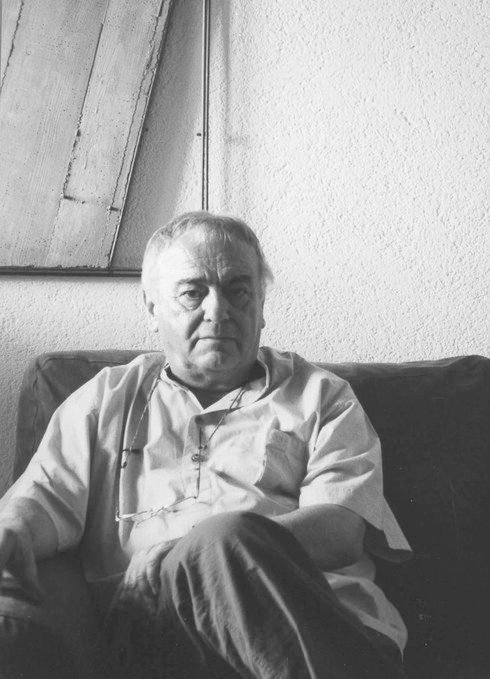
Giuseppe Uncini was born in Fabriano in 1929 and died in Trevi in 2008. After his early years of activity in his home town, he moved to Rome in 1953, where he came into contact with artists and environments that were decisive for post-war Italian culture. The Roman experience brought him into contact with Informel research, material experimentation and new ideas on the relationship between work, process and space. In 1955, he participated in the VII Rome Quadriennale; in 1957, he exhibited in Germany in the exhibition “Abstrakte Italienische Kunst”, soon signalling an international opening.
From the Terre to the Cementarmati
In the second half of the 1950s, Uncini began the “Terre” (Earths) cycle, creating surfaces with tuff, sand, ash and pigments. The turning point came between 1957 and 1958 with the first “Cementarmati” (Reinforced Concretes), works in concrete, iron and wire mesh. The material was not used to hide the construction process, but to show it. The load-bearing structure, the reinforcement and the traces of the formwork became visible elements of the work, making construction and form coincide.
Material as Thought
Uncini attached great importance to the concreteness of materials. Concrete and iron are associated with building, engineering and the transformation of the landscape; in his works, they are removed from their practical function and converted into tools of knowledge. The material retains its own identity, but also becomes measure, rhythm, surface and volume. Sculpture is no longer necessarily a modelled body or a represented figure: it can be the manifestation of a construction process, with its forces, its constraints and its traces.
Structure and Space
From the Cementarmati to subsequent series, including the “Ferrocementi” and the “Strutture-spazio”, Uncini developed a coherent research into the way in which form defines space and, at the same time, makes its relationships visible. The cast shadow, the distance from the wall and the relationship with the floor are essential parts of the work. The sculpture is not limited to the material volume: it extends into the environment through lines, intervals and empty zones. Space becomes something that can be measured and perceived thanks to the structure.
Gruppo Uno and Historical Context
In 1962, Uncini participated in the foundation of Gruppo Uno together with other artists interested in reflecting on the role of art in contemporary society. The group confronted the need to overcome both individual expressionism and the idea of the work as a purely decorative object, valuing project, method and collective research. Uncini’s position, however, remained strongly personal: the rigour of the process did not eliminate the sensory quality of the materials, but made it an integral part of the meaning.
Legacy and Importance
Uncini is recognised as a fundamental figure in the redefinition of Italian sculpture in the second half of the twentieth century. His work anticipates central issues for contemporary art: the visibility of the process, the relationship between object and environment, the expressive value of industrial materials and the possibility of making the project a poetic component. His sculptures seek neither illusion nor traditional monumentality; instead, they make legible the way in which a form is constructed and occupies space. It is precisely this structural clarity, combined with the physical strength of concrete and iron, that keeps their intensity intact.