
Image, City, and POP ART in Italian Painting
Early Life and Training
Mario Schifano was born in Homs, Libya, in 1934 and moved to Rome with his family during the Second World War. After working as a restorer at the Etruscan Museum of Villa Giulia, he became a self-taught painter.
In the late 1950s, he made his debut in the Roman art scene, and in 1960, he presented his first monochromes at Galleria La Salita, works that immediately attracted critical attention.
Monochromes and the New Image
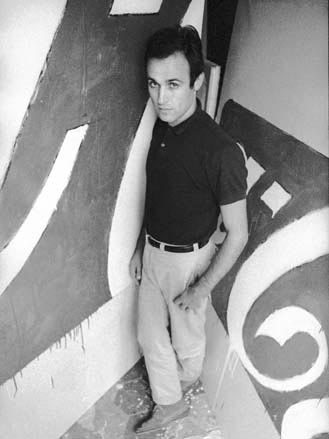
Schifano’s monochromes transform the pictorial surface into a kind of screen. Their initial simplicity is progressively contaminated by letters, numbers, signs, and fragments from urban communication.
His engagement with contemporary visual culture led Schifano to confront American Pop Art, without, however, abandoning the gestural and pictorial component of his own artistic exploration.
Mass Culture and the United States
In 1962, he participated in ‘The New Realists’ exhibition at the Sidney Janis Gallery in New York. In 1963, he made his first trip to the United States, where he came into contact with artists such as Jasper Johns and Andy Warhol.
His encounter with American society reinforced his interest in advertising images, industrial brands, photography, cinema, and television, which he transformed into pictorial materials.
Television, Photography, and New Series
In the 1960s and 1970s, Schifano used emulsified canvases, paper, plexiglass, collage, and photo-impressions. Series such as ‘Paesaggi TV’ (TV Landscapes), ‘Tutte stelle’ (All Stars), and ‘Gigli d’acqua’ (Water Lilies) emerged, in which images from mass media were reassembled through a rapid and layered language.
Concurrently, he developed an intense interest in cinema and created numerous films and experimental works, expanding his artistic exploration beyond the confines of painting.
The 1980s and Recognition
From the 1980s, Schifano returned to large-format painting with vibrant colours, maintaining his interest in contemporary imagery and the superimposition of signs.
He participated multiple times in the Venice Biennale and numerous international exhibitions. His work entered the collections of important Italian and foreign museums.