
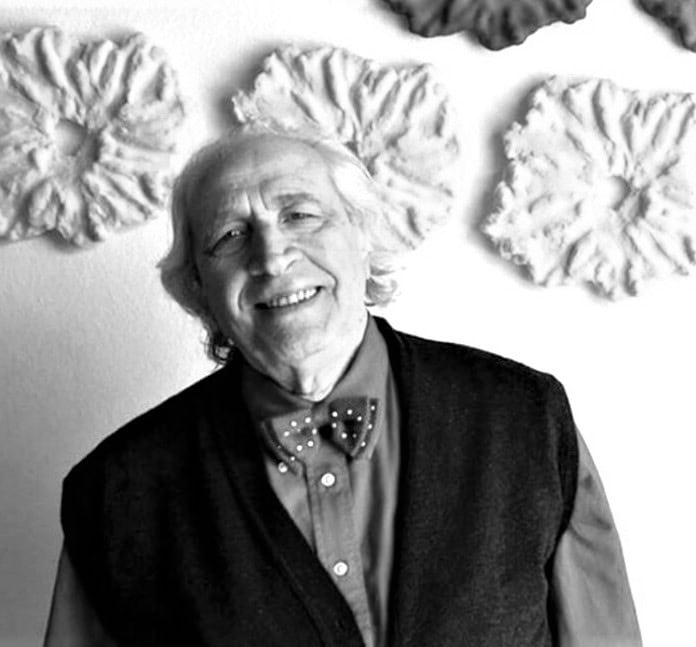
Painting, fragment and dissemination
Background and early years
Pino Pinelli was born in Catania in 1938 and moved to Milan in 1963, coming into contact with a particularly vibrant artistic environment. At the time, the city was a hub for the intersection of painting, design, programmed art and new international research. Pinelli developed a line of inquiry that, starting from painting, came to challenge the centrality of the painting as a single, delimited surface. His work is one of the most recognisable examples of Italian Analytical Painting.
The crisis of the painting
In the 1970s, Pinelli began a reflection on painting as a material field, focusing on colour, support and physical presence. The canvas was no longer considered a neutral container for an image, but an element that could be transformed and decomposed. This investigation gave rise to the works known as “Pittura R”, in which the pictorial surface was articulated into distinct elements. The painting thus lost its traditional unity and opened up to real space.
Dissemination
The concept of dissemination is central to his research. The painted elements, often shaped and coated in colour, are distributed across the wall in configurations that can vary from work to work. They do not necessarily form a closed composition: they relate to each other through distances, intervals and rhythms. The wall becomes an integral part of the work, while the void assumes an active role. Painting no longer coincides with a rectangle, but manifests as a diffused presence in space.
Colour and surface
Colour is the absolute protagonist. Pinelli often uses intense, compact tones, applied with a care that enhances the consistency and luminosity of the surface. The pictorial matter envelops the elements, giving them an almost autonomous presence. Colour does not describe or symbolise: it is a visual and physical experience. Its intensity is perceived in its relationship with light and the wall, while the repetition of elements creates a rhythm that engages the viewer’s gaze.
Career and recognition
Pinelli has exhibited in major Italian and international galleries and institutions, consolidating a central position in the history of contemporary painting. His research has been read in relation to Analytical Painting, but the dissemination and transformation of the painting into an installation have given his work a recognisable specificity. Over the decades, he has developed different chromatic and formal cycles, maintaining a constant focus on the relationship between painting, space and perception.
Critical interpretation
Pino Pinelli’s painting overcomes the traditional opposition between painting and installation. The surface is fragmented, but does not lose its pictorial identity; on the contrary, colour acquires a more direct and engaging presence. The wall is not a passive background, but rather an active element in the construction of the work. The void between the fragments becomes part of the language, transforming the vision into a rhythmic and spatial experience.