
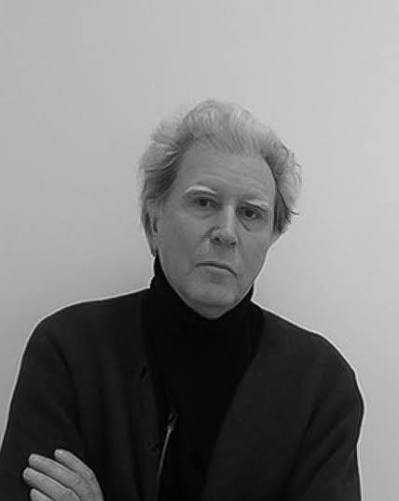
Sculpture, Painting, and the Moving Figure
Education and Early Years
Roberto Barni was born in Pistoia in 1939 and lives and works in Florence. A self-taught artist, he began oil painting in the early 1950s and produced his first abstract works in 1959, experimenting with various materials such as wood, iron, photography, and paper. His first exhibitions date back to the early 1960s. In the Pistoia context, he established connections with Umberto Buscioni and Gianni Ruffi, sharing with them the period of the so-called Scuola di Pistoia, characterised by an exploration open to images of contemporary society and new languages.
From Experimentation to Painting
Barni’s artistic journey does not follow a single stylistic direction. After early works linked to industrial images, topographies, and landscapes, the artist explored experiences close to conceptual and minimalist research. In the early 1970s, he decisively returned to painting and art history, developing a personal figuration that was cultured and deliberately anachronistic. The term “anachronism”, which he used in 1976, indicates a freedom from trends and chronology: the artist can draw from different eras and languages without having to consider them outdated.
The Figure and the Body
The human figure progressively became the focal point of his research. Barni’s characters are not individual portraits, but symbolic presences, often placed in situations of waiting, precarious balance, or movement. The body appears isolated, sometimes bandaged or engaged in enigmatic actions. Its condition suggests a reflection on existence, on the difficulty of orientation, and on the need to find a relationship with the world. The artist avoids explicit narration, entrusting meaning to posture, gesture, and the relationship with objects.
Painting and Sculpture
Painting and sculpture constitute two communicating dimensions. In his canvases, the precision of drawing and the quality of the material construct images suspended between tradition and invention. In sculpture, especially in bronze, figures acquire a physical presence and engage with real space. Works such as “Servi Muti” (Mute Servants) translate an existential condition into volume: bodies and forms seem to retain an energy that cannot transform into action. Sculpture does not illustrate painting, but develops its themes and metaphors within an environmental dimension.
Exhibitions and Recognition
Barni participated in the Venice Biennale in 1984 in the painting section and in 1988 in the sculpture section. He has exhibited in Italy, Europe, and the United States, with significant presences at the Queens Museum in New York. His works are held in public and private collections, including the Gori Collection in Celle, the Luigi Pecci Centre for Contemporary Art in Prato, the Uffizi, and international institutions. Collaborations with architects and the creation of environmental works have further expanded his relationship with public space.
Critical Interpretation
Roberto Barni’s research demonstrates how figuration can be contemporary without renouncing the memory of tradition. His universe is populated by figures that seem to come from an indefinite time and, precisely for this reason, assume a universal dimension. Irony coexists with melancholy, the solidity of sculpture with the instability of gestures. His work invites us to consider humanity as a fragile and mobile presence, continually striving to find a balance between its own body, objects, and space.