
The wall, the mark, and the birth of a new urban language
Training and arrival in Berlin
Thierry Noir was born in Lyon in 1958. In 1982, he moved to West Berlin, where he lived in close contact with the Wall and the vibrant cultural scene of Kreuzberg.
His Berlin experience became decisive in the construction of a language based on simple forms, sharp colours, and immediately recognisable figures.
Painting on the Berlin Wall
In 1984, Noir began painting the Berlin Wall illegally, becoming one of the first artists to intervene systematically on its surface. He worked quickly, also using materials found in construction sites and urban spaces.
His simplified images, often consisting of profiles, heads, animals, and brightly coloured figures, transformed the wall from a symbol of political division into a surface for communication and protest.
Figurative language
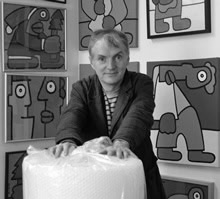
Noir’s painting is based on a radical economy of form. The drawing is reduced to a few essential strokes and colour assumes a structural function, creating images that are immediately legible even from a great distance.
This simplicity arose from the physical and political conditions of painting on the wall and subsequently became the principle of a personal language applied to canvases, sculptures, prints, and large murals.
From public space to the studio
After the fall of the Wall in 1989, Noir continued to develop his research, maintaining a constant relationship between public space and studio practice. The images born in Berlin were transferred to different supports and adapted to new dimensions.
His production includes painting, sculpture, graphics, and mural interventions, always maintaining a strong formal recognisability.
International path
Over the years, Noir’s work has been presented in numerous international exhibitions and in important contexts dedicated to urban culture and contemporary painting. His works are held in museum collections in various countries.
His experience on the Berlin Wall contributed to placing him in the history of street art and contemporary urban painting, while maintaining a practice that also includes work on traditional supports.