
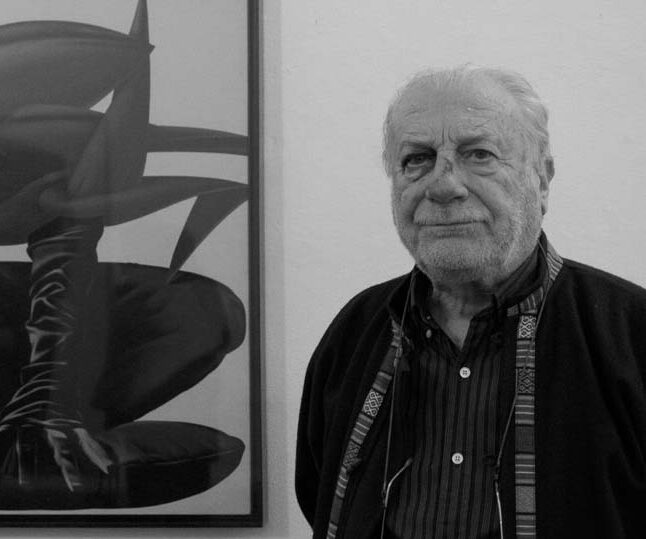
Research into drapery: between painting, matter and illusion
Training and early years
Umberto Mariani was born in Milan on 16 November 1936. He trained at the Brera Academy, where he attended the school of Achille Funi, later becoming his assistant. Between 1959 and 1965, he collaborated with the master on the creation of important fresco decorations, experiences that allowed him to acquire a solid technical preparation and a particular ability to work on large surfaces.
Encounters with artists such as Constant Permeke and Graham Sutherland contributed to the maturation of his language, orienting him towards a personal research in which figurative tradition, expressionism and experimentation coexist.
The Alarming Objects and the Aphonic Alphabet
From the second half of the 1960s, Mariani developed the Alarming Objects cycle (1967–1974), compositions in which furniture elements and everyday objects are assembled to create ambiguous and anthropomorphic figures. Through a language close to Pop Art, the artist reflects on the transformations of contemporary society and the spread of consumer culture.
In 1974, he began the Aphonic Alphabet cycle, in which large letters are wrapped and hidden by drapery and fabrics. The word thus loses its communicative function, becoming a silent and symbolic image. The theme of drapery progressively assumed a central role in his research.
Theatrical installations and research into drapery
Between the late 1970s and the early 1990s, Mariani created installations characterised by a strong scenographic component. He used various materials, including wood, fabrics, lamps and objects, constructing settings that recall the metaphysical interiors of Giorgio de Chirico and the surreal atmospheres of René Magritte.
These works develop a relationship between reality and illusion, presence and absence, through research that goes beyond the boundaries of traditional painting and involves the exhibition space.
The Leads: form and matter
From 1992, Mariani began the Leads cycle, the most representative phase of his production. The artist uses thin lead sheets, worked and modelled to reproduce the soft and sinuous effect of fabrics and drapery.
Through a surprising contrast between the heaviness of the material and the apparent lightness of the folds, he creates monochrome surfaces in which light and shadow become fundamental elements of the composition. In some works, the drapery hides an underlying form, giving rise to the so-called Hidden Forms.
The reference to classical and Byzantine tradition is thus combined with a contemporary sensitivity, in a research that transforms matter into visual illusion.
Exhibition path and international recognition
Throughout his career, Mariani has exhibited in major international institutions and galleries, participating in exhibitions in Europe, the United States and Asia.
Key solo exhibitions include The Robes of Saturn at Palazzo Medici Riccardi in Florence in 2011 and Fragments from Byzantium, presented in 2018 at the National Museum of Ravenna and subsequently in Rome, before arriving in 2019 at the Hermitage Museum in St Petersburg. In 2020, he also presented a solo exhibition at the Gallerie d’Italia in Milan and in 2021 at the Palazzo Ducale in Mantua.
In 2022, he was present at the Venice Biennale with the installation I Do Not Bend. In 2026, the Vittoriale degli Italiani will dedicate the exhibition Bending Lead, Constructing Light to him.
Critical interpretation
Umberto Mariani’s research is distinguished by the ability to combine a deep knowledge of artistic tradition with a plastic and contemporary language. Drapery, a recurring element in the history of painting and sculpture, becomes the centre of an investigation into form, matter and perception.
In the Leads, the contrast between the rigidity of the metal and the apparent softness of the folds generates a particular visual tension, in which the material seems to lose its weight and transform into fabric.
His work moves constantly between abstraction and figuration, classical memory and experimentation, giving life to a personal language in which light, surface and illusion play a fundamental role.