
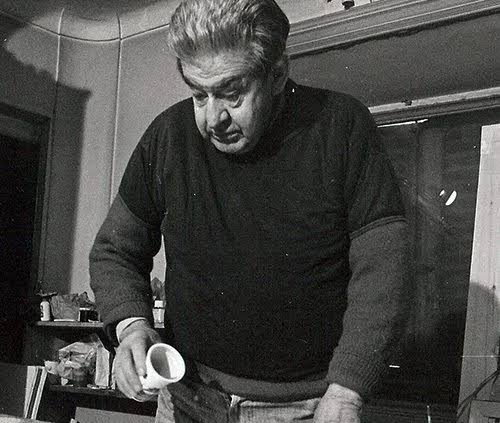
Colour, Matter, and Freedom in Italian Abstraction
Education and Early Years
Giulio Turcato was born in Mantua in 1912 and grew up in Venice, where he attended the Institute of Art. In 1936, he moved to Milan, coming into contact with the Corrente movement and initially developing an Expressionist-influenced painting style.
During the war, he moved to Rome and participated in the Resistance. In the post-war period, he joined the debate on the renewal of Italian art, contributing to the founding of Art Club and Forma 1.
Forma 1 and Abstraction
In 1947, Turcato was among the founders of Forma 1 alongside Carla Accardi, Piero Dorazio, Achille Perilli, Pietro Consagra, Antonio Sanfilippo and other artists. The group advocated a new conception of abstraction, capable of engaging with international avant-gardes.
His research is distinguished by a strong chromatic freedom and a continuous oscillation between sign, form, and matter.
Fronte Nuovo delle Arti and Gruppo degli Otto
In 1946, he joined the Nuova Secessione artistica italiana, later Fronte Nuovo delle Arti, an experience that brought together diverse trends in post-war Italian painting. After the group disbanded, he joined the Gruppo degli Otto, supported by Lionello Venturi.
In 1960, he also joined the Continuità group, pursuing research aimed at overcoming traditional categories.
Matter, Colour, and Non-Objective Forms
Turcato developed a language in which chromatic surfaces, dynamic signs, and different materials coexist. His works can feature flat colour fields, networks of lines, multi-material inserts, and fluorescent forms.
His interest in matter and colour is accompanied by a particular attention to biological sciences and the relationship between natural forms and abstract construction.
Exhibition History and Recognition
Turcato participated in numerous editions of the Venice Biennale and the Rome Quadriennale, as well as important international exhibitions. From 1953 to 1982, he taught at the Art Lyceum in Rome.
In the 1980s, he expanded his activity to include set design and visual arts. In 1992, the Rome Quadriennale dedicated a significant retrospective to him.
Critical Interpretation
Turcato’s work represents one of the freest and most experimental paths in post-war Italian abstraction. His language traverses Expressionism, Abstractionism, Informel, material research, and chromatic experimentation.
Colour constitutes the unifying element of his work: at times matter, at times surface, at times luminous sign. This freedom allows him to maintain a constant relationship with the present and with the transformations of contemporary culture.