
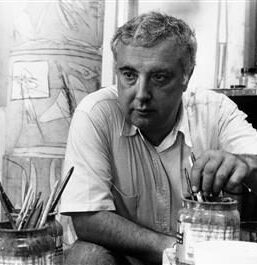
Geometric Imagination: Abstraction, Sign, and Space
Formation and Forma 1
Achille Perilli was born in Rome in 1927. In 1947, he was among the founders of Forma 1, alongside Carla Accardi, Piero Dorazio, Pietro Consagra, Antonio Sanfilippo, Giulio Turcato, and other artists. The group advocated an abstract and formalist stance, engaging in dialogue with European avant-gardes.
Alongside his painting, Perilli pursued intense theoretical and cultural activities, contributing to discussions on contemporary art through magazines, manifestos, and exhibition initiatives.
From Geometry to Sign
In the 1950s, he developed an abstract language in which geometric forms and graphic signs coexisted with increasing compositional freedom. His painting did not seek a rigorously rational geometry, but rather a structure capable of accommodating imagination and movement.
In 1949, he joined MAC (Movimento per l’Arte Concreta – Movement for Concrete Art), entering the Italian debate on non-figurative research.
L’esperienza moderna and Grammatica
Between 1957 and 1960, he co-edited the magazine L’esperienza moderna with Gastone Novelli, while in 1964, he participated in the founding of Grammatica. The theoretical dimension consistently accompanied his pictorial work.
Perilli also experimented in theatre, creating sets, costumes, and projects in which the relationship between space, image, and movement expanded his conception of the artwork.
The Mad Image and Imaginary Space
From the 1960s, his research progressively moved away from traditional geometry to develop mobile, fragmented, and fantastical forms. In 1971, he published the Manifesto della Folle Immagine nello Spazio Immaginario (Manifesto of the Mad Image in Imaginary Space).
The 1970s saw the emergence of his so-called ‘machineries’ and ‘mutant structures’, in which the sign constructs unstable and imaginary spaces, far removed from traditional perspective.
Exhibition History and Recognition
Perilli participated in significant international exhibitions, including the Venice Biennale in 1962 and 1968, and was the subject of numerous solo and retrospective exhibitions in Italy and abroad.
Among the most notable events were retrospectives at the Galleria Nazionale d’Arte Moderna in Rome, the Institut Mathildenhöhe in Darmstadt, and the MART in Rovereto.
Critical Interpretation
Perilli’s research is distinguished by his ability to use geometry as a starting point for a free, imaginative, and anti-rationalist painting. Form is not a definitive structure, but an element in continuous transformation.
His work contributed to making post-war Italian abstraction a field open to theoretical experimentation, the sign, and the construction of mental spaces.