
Light, Form, and Space in Contemporary Abstraction
Education and Early Years
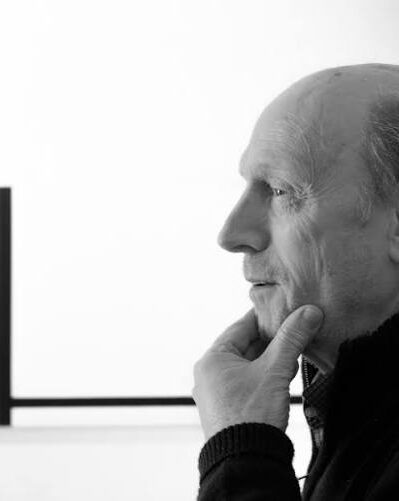
Bruno Querci was born in Prato in 1956, where he continues to live and work in the Tuscan city. From the 1980s onwards, he developed a rigorous pictorial exploration, focused on the reflection of form, light, and the perception of space.
His work is situated within the context of contemporary Italian abstraction and is associated with the experiences of the so-called Poor Abstraction.
Form and Light
Querci’s research stems from a desire to investigate light as a fundamental condition of form. His works are characterised by essential colour fields and a controlled use of black and white.
The contrast between reflection and absorption of light constructs surfaces where form appears and disappears, transforming painting into a perceptive experience.
Painting and Space
In the 1990s, Querci developed series such as ‘Figure dello scuro’ (Figures of Darkness), ‘Corpi di luce’ (Bodies of Light), ‘Formaspazio’ (Formspace), and ‘Naturaenergialuce’ (Natureenergylight). The relationship between surface and depth became central, with works in which painting seems to open a space beyond the canvas’s boundary.
His language remains aniconic and rigorous, yet it does not forgo a sensitive and almost environmental dimension.
The Relationship with Morterone
An important part of Querci’s research is linked to Morterone, a place where the relationship between art, nature, and space takes on particular significance. The works presented in this context develop the idea of form as energy in relation to the environment.
Nature is not directly represented but becomes a conceptual and perceptive condition through which to reflect on light and space.
Exhibition History
Querci has exhibited in Italian galleries and public spaces since the 1980s. Notable exhibitions include those at Galleria Peccolo in Livorno, A arte Studio Invernizzi in Milan, CAMeC in La Spezia, and CaMusAC in Cassino.
He has participated in important surveys of Italian abstraction, including ‘Astratta. Secessioni astratte in Italia dal dopoguerra al 1990’ and ‘Die andere Richtung der Kunst. Abstrakte Kunst Italiens ’60-’90’.
Critical Interpretation
Bruno Querci’s painting is based on the reduction of elements and perceptive concentration. Black and white become tools to make visible the relationship between light, matter, and space.
His work is situated within a rigorous abstract tradition, where painting becomes a threshold between the visible and the invisible, and form takes on the value of an experience rather than a representation.